Discovery guide · budget alternatives
A drawer full of fitted compartments looks satisfying. A few clean boxes can tell you whether those compartments would help before you pay for them. The useful bargain is sometimes the experiment, not the product.
Budget shopping works best when it begins with a narrowly defined task. “Make the desk better” invites a cart full of accessories. “Stop this charging cable falling behind the desk” gives you something concrete to solve and a clear way to judge whether a solution works.
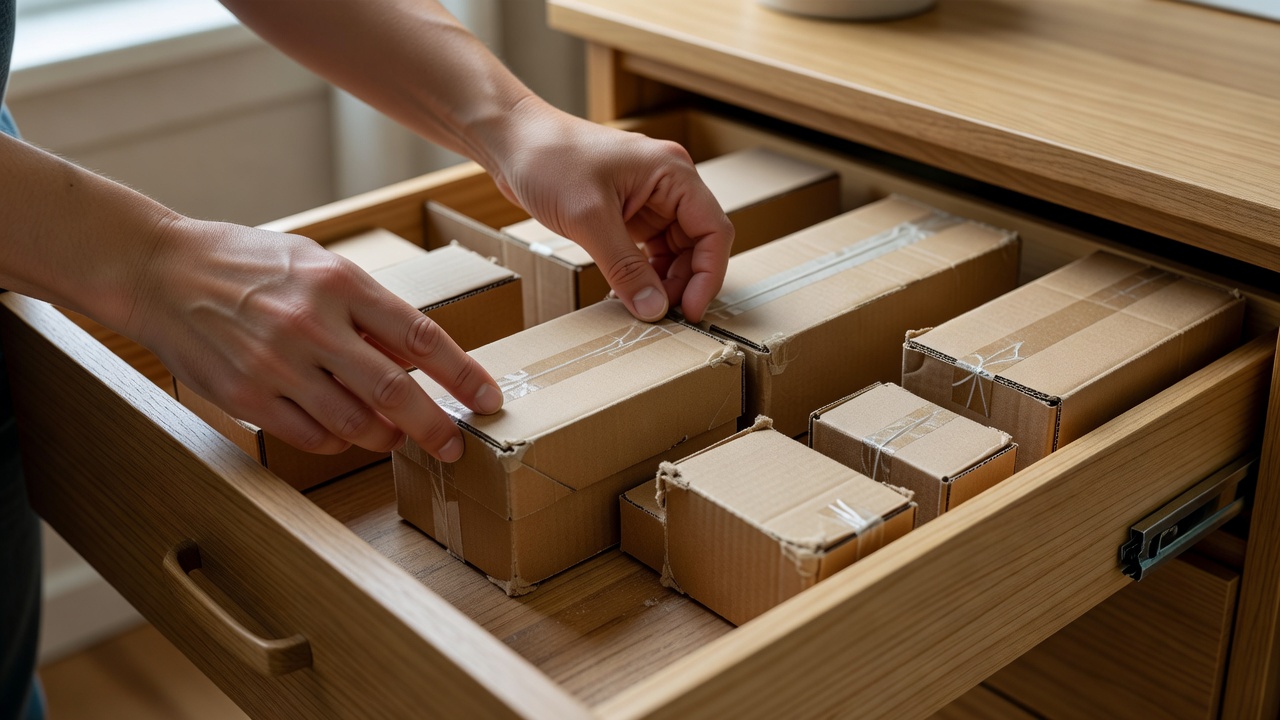
Make the free version informative
Start with rearrangement, an existing suitable tool or a temporary layout. The aim is not to prove that buying is always wasteful. It is to learn which part of the problem actually needs solving. If a free arrangement succeeds but looks untidy, you can decide whether appearance alone justifies the upgrade.
Reuse has limits. Do not improvise mains electrical accessories, bypass safety devices or use containers for food when they are unsuitable for that purpose. A household shortcut should not turn uncertainty about materials or load limits into a safety experiment. Savings are not useful if they introduce a new risk.
For drawer organisation, clean dry boxes can help test categories in an appropriate dry location. For a crowded counter, relocating rarely used objects may outperform a new shelf. For a hard-to-reach item, moving it lower can be better than buying a reacher. Each trial should answer a question about the routine.
One falling cable, three answers
Consider a fixed desk in a dry room where a charging lead keeps slipping behind the edge. Our first editorial choice is an existing reusable cable tie, loosely arranged around a suitable anchor if one is already available. Leave enough slack for normal movement, avoid sharp edges and do not pinch the cable or obstruct ventilation.
The second option is a removable cable clip. It makes sense when the layout is stable and there is an appropriate surface. Check the cable diameter and the adhesive's installation and removal instructions. “Removable” is not a guarantee that a delicate finish will remain unmarked. Test only as directed and do not attach clips where heat or moisture makes them unsuitable.
The third option is a cable tray. It can organise several leads and compatible equipment, but is excessive for a single drifting connector. Installation may require drilling, clamping or adequate desk clearance. Keep power equipment ventilated and follow its instructions; hiding a tangle does not make an overloaded or damaged setup safe.
This order changes when the problem changes. A shared desk that must be cleared daily may favour a portable organiser. A desk with no safe anchor makes the reused tie unsuitable. Rankings should expose their assumptions, not hide them behind a universal “best” label.
Count the cost after checkout
A low sticker price can be offset by delivery charges, replacement pads, proprietary refills, batteries, additional cables or a difficult return. Compare the complete working arrangement. If a product needs a subscription for its central feature, include that ongoing commitment rather than treating it as a footnote.
Cost per use can be a helpful thought experiment, but it is not a prediction. Estimate realistically how often you perform the task and how likely you are to keep using the tool. Do not invent a precise lifespan to make an expensive purchase look mathematically inevitable.
Know where cheaper is not the goal
For electrical products, load-bearing accessories, food-contact equipment and sharp tools, suitability and credible documentation matter more than a dramatic discount. Check the exact seller, model, safety information and applicable local requirements. A familiar marketplace name does not establish the quality or legitimacy of every third-party listing.
Second-hand can be sensible for straightforward, inspectable items, but condition matters. Check for damage, missing parts and recalls. Some products are inappropriate to buy used when their history or remaining integrity cannot be assessed reliably. When uncertain, get qualified advice or choose a better-documented option.
Give doing nothing a fair comparison
A small annoyance that happens rarely may not deserve a permanent purchase. Conversely, a modest tool used every day can be a better value than a free workaround that is tiring or inaccessible. Time, physical effort and ease of use count, even when they are not printed on a receipt.
Our budget lens is simple: solve the actual problem with the least unnecessary burden. Sometimes that means spending nothing. Sometimes it means paying more once for a suitable, maintainable solution. The win is not owning the cheapest collection of objects. It is needing fewer disappointing replacements.